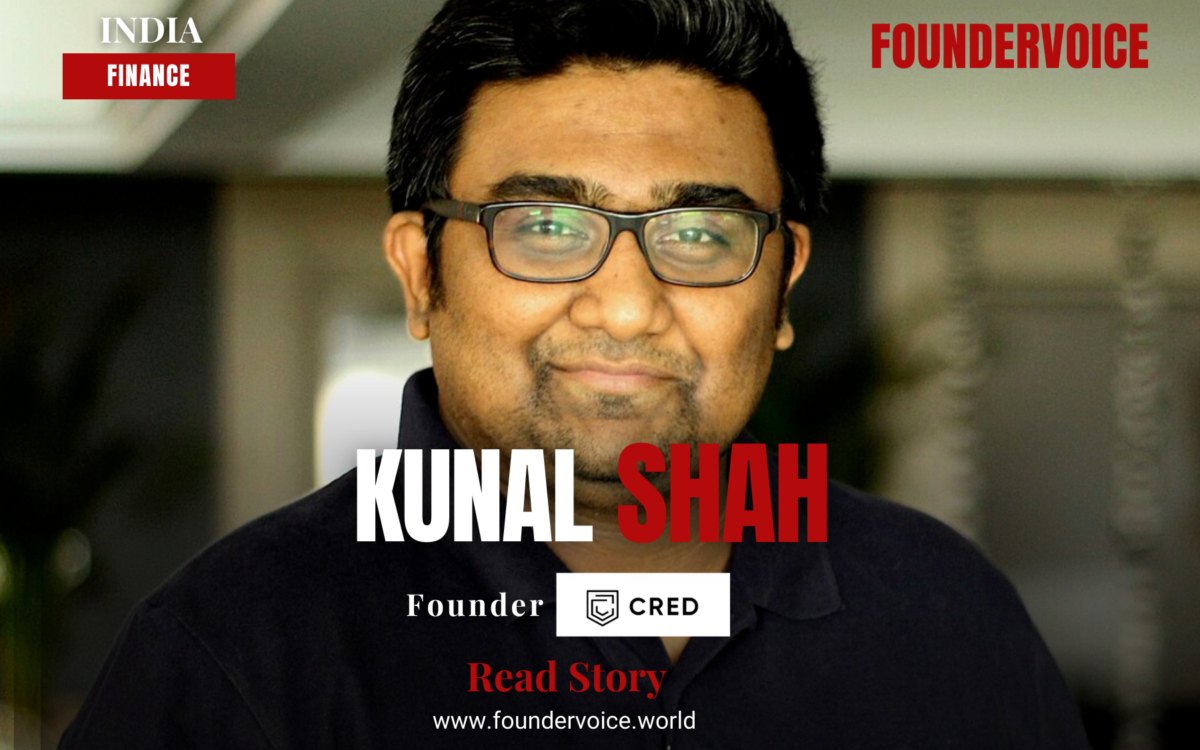


Kunal Shah’s story is an inspiring story. He is the founder of CRED, which was started in November 2018 in Bengaluru, India. Today, CRED’s valuation is estimated to be over 6 billion US dollars. The company serves more than 16 million active users across India. CRED helps people manage their credit card payments, improve financial discipline, and access exclusive rewards through a trusted and transparent platform. The platform addresses the challenge of scattered financial data, delayed payments, and lack of incentives, offering members a simple solution to manage credit responsibly while enjoying unique benefits.
Company Overview
| Origin Country | India |
| Legal Name | Dreamplug Technologies Private Limited. |
| Brand | CRED |
| Founder | Kunal Shah |
| CEO | Kunal Shah |
| Industry | fintech industry |
| Website | cred.club |
| Year of Founding | 2018 |
| Valuation | $3.5 billion. |
| Employees | 800-900 |
| Headquarters | Bengaluru |
| Status | Active |
FOUNDER OVERVIEW: KUNAL SHAH
➤ Net Worth (2025)
Recent reports estimate Kunal Shah’s net worth (mainly derived from his stake in CRED and other investments) to be in the ballpark of US $600–750 million
➤ Ownership in Company
He continues to hold a significant ownership stake in CRED, believed to be between 15–20 percent, despite multiple funding rounds. His financial philosophy is unconventional: he prefers a minimalist lifestyle, avoids unnecessary luxury, and focuses on reinvesting earnings into ventures that drive long-term value.
He has openly stated in several interviews that he does not believe in owning too many material possessions and values time, learning, and experimentation more than wealth. His salary style has always been modest; even during his previous venture, FreeCharge, his priority was product innovation rather than personal wealth accumulation.
➤ Ventures Founded
1. PaisaBack (2009) – Cashback & Coupon Startup
Kunal’s first entrepreneurial attempt, PaisaBack, focused on providing cashback to users shopping online. Although the venture eventually shut down, it gave him deep insights into user behavior, engagement, and consumer psychology. This learning laid the foundation for FreeCharge.
2. FreeCharge (2010) – Digital Recharge & Payments
FreeCharge became one of India’s most loved recharge platforms. It allowed people to recharge mobiles and DTH services while getting equivalent value back in coupons. In 2015, it was acquired for one of India’s largest startup exits at the time. Kunal stayed for a short period post-acquisition but moved on to pursue new ambitions.
3. CRED (2018) – Fintech Platform for Creditworthy Individuals
CRED was built with a simple philosophy: reward trustworthy, financially responsible individuals. It became one of India’s fastest-growing fintech brands due to its design-first approach, reward-driven ecosystem, and focus on improving financial behavior across India’s rapidly growing credit card user base. company by him publicly documented in sources; his focus remains on scaling Physics Wallah.
➤ Investments
Kunal Shah is one of India’s most active angel investors. His investments span technology, finance, education, and FMCG. Some sectors where he has made notable investments include:
- Fintech – Supporting startups that promote financial inclusion and innovative credit solutions.
- SaaS – Investing in early-stage cloud and productivity tools.
- Consumer Apps – Backing brands that understand Indian consumer psychology.
- Web3 & Future-Tech – Exploring the next generation of digital ecosystems.
His investment philosophy revolves around backing founders who possess curiosity, strong reasoning skills, and the ability to understand user behavior deeply.
➤ Recognition & Awards
Economic Times Startup Award (Founder Category) — Recognized for building one of India’s most innovative fintech companies.
Forbes India Leadership Recognition — Honored for transformative contribution to the Indian digital economy.
GQ India Business Icon — Acknowledged for redefining consumer finance and inspiring young entrepreneurs.
These awards reflect his influence on India’s startup ecosystem, especially in the fintech sector.
➤ Connect with Founder on Social Media
PERSONAL STORY: KUNAL SHAH
Kunal Shah was born in 1983 in Mumbai, Maharashtra, into a middle-class Gujarati family. His father ran a small business, and his mother was a homemaker. Growing up in a business-centric Gujarati household, Kunal learned early lessons in money, responsibility, and practical decision-making.
His childhood was shaped by simplicity and middle-class values, where every purchase required thought and every rupee had meaning. These experiences later influenced his deep interest in consumer behavior and economic incentives.
Before entrepreneurship, Kunal worked in several roles that helped him understand India’s complex customer psychology. He briefly pursued an MBA but dropped out because he believed traditional education did not satisfy his curiosity.
He was always more interested in understanding how people behave, how they make financial decisions, and why they act the way they do. He believed India had enormous potential but lacked a system that rewarded good financial behavior.
Kunal completed his bachelor’s degree in philosophy from Wilson College, Mumbai. Studying philosophy shaped his thinking style and ability to question everything logically.
While most entrepreneurs come from engineering or business backgrounds, Kunal used philosophical frameworks to decode consumer patterns and market gaps, something that became his competitive edge.
Kunal faced financial challenges early in life. His family went through a challenging phase due to business instability, forcing him to work multiple side projects to support himself. He often mentions how these struggles made him resilient and built his belief that financial discipline is one of the strongest forms of empowerment.
Dropping out of MBA also brought criticism and self-doubt, but he remained firm because he valued learning over degrees. As a founder, he faced many rejections, failures, and moments of uncertainty, especially during the early phase of PaisaBack and FreeCharge.
Kunal’s biggest personal triumph was discovering clarity: understanding that his real strength lies in decoding incentives, understanding user behavior, and building systems that nudge people toward better habits.
His success came not just from money but from seeing millions of Indians benefit from digital payments, rewards, and better financial habits.
He is admired for his humility, humor, and ability to explain complex economic ideas in simple language. His personal philosophy — “people respond to incentives” — guides his decisions even today.
FOUNDING STORY: CRED
Inspiration Behind the Idea
The idea of CRED came from a simple observation: in India, people who pay their bills on time do not receive any reward, while irresponsible behavior often comes with no consequence.
Kunal realized that the credit economy in India was broken — financially responsible individuals had no advantage.
He wanted to fix this.
CRED was born in November 2018 in Bengaluru to reward trust, responsibility, and good financial habits.
Founding Team
Kunal started CRED as a single founder but built a strong core team of product designers, engineers, and thinkers.
He brought people together who believed that India needed a shift from a low-trust society to a high-trust ecosystem.
The team trusted his vision because of his proven experience with FreeCharge and his deep understanding of incentives.
Starting Capital
CRED began with early funding from leading investors who trusted Kunal’s track record.
The company started modestly but scaled quickly because of its design-first approach.
Kunal reinvested his own money and took significant personal risks because he believed the idea would redefine India’s financial landscape.
Early Challenges
The early phase was filled with challenges:
- People did not understand why they should be “rewarded” for paying bills.
- Many questioned the business model.
- Building trust in a fintech brand required flawless execution.
- The app needed to be extremely secure, fast, and reliable.
There were technical hurdles, data management complexities, and skepticism from industry experts.
But the team remained focused on creating an elite member experience that felt premium, smooth, and deeply rewarding.
Breakthrough
CRED’s breakthrough moment came when users started experiencing the app’s simplicity: pay credit card bills, get rewards instantly.
The app’s clean design, luxurious feel, and smooth user flow set a new standard in Indian fintech.
Partnerships with top brands, TV campaigns during IPL, and word-of-mouth from satisfied users rapidly boosted growth.
CRED soon became a cultural phenomenon — an app for financially responsible individuals who cared about rewards, discipline, and lifestyle.
COMPANY PROFILE: CRED
CRED is a fintech platform that helps creditworthy individuals manage credit card payments, check credit scores, and access rewards and financial products. It aims to reward trustworthy behavior and make finance smoother, transparent, and more enjoyable.
Area Served
CRED primarily serves India, with deep penetration in urban and semi-urban regions such as:
- Tier-1 Cities – Delhi, Mumbai, Bengaluru, Chennai, Hyderabad, Kolkata
- Tier-2 Cities – Pune, Jaipur, Lucknow, Chandigarh
- Expanding Reach – Increasing adoption in emerging financial hubs
Headquarters: Bengaluru, Karnataka.
Vision & Mission
Vision: To build India’s most trusted financial ecosystem that rewards good behavior
Mission: To empower people with better financial tools, transparent systems, and meaningful rewards.
Services / Products Offered
- Credit Card Bill Payments
- Credit Score Tracking
- CRED Pay for seamless checkout
- CRED Stash (Instant Credit)
- CRED RentPay
- CRED Mint (Peer-to-peer investment)
- Rewards, Coins, Cashbacks
- Lifestyle, Travel & Brand Partnerships
Business Model
CRED delivers value through an exclusive member-only ecosystem.
The platform focuses on high-trust users with good credit scores.
Brands partner with CRED to reach premium customers.
CRED also earns from:
- Financial products
- Payments
- Credit marketplace
- Brand promotions
Revenue Model
- Subscription-like revenue through financial services
- Merchant partnerships
- Commission from CRED Pay
- Interest margins through credit products
- Transaction-based revenue
- Lead generation partnerships
Market Landscape & Competitors
By 2025, India’s fintech ecosystem is one of the fastest growing in the world.
CRED competes with:
- Paytm – Wallet, UPI, financial services
- PhonePe – Payment ecosystem
- Bajaj Finserv – Consumer credit
- LazyPay & Slice – Credit products
- Bank apps – Direct card payments
USP (Unique Selling Proposition)
CRED stands out due to its design-first experience, reward-driven model, premium customer base, and deep understanding of financial behavior.
Growth Highlights
- 2018 – CRED launched
- 2019 – Rapid user adoption
- 2020 – CRED Pay introduced
- 2021 – Became a unicorn
- 2022 – Expansion into credit and investment products
- 2023-2025 – Growth in financial marketplace offerings
Funding & Investment History
CRED is funded by major global investors and operates with strong market confidence due to Kunal Shah’s leadership.
Awards & Recognition (Company)
CRED has received recognition for innovation, design, and consumer engagement across India.
Team Size & Culture
CRED has over 2,000 employees across India, known for a culture of experimentation, high ownership, and fast execution.
Future Plans
- Expanding financial products
- Larger ecosystem for premium users
- Strengthening credit marketplace
- Deeper integration of rewards and loyalty programs
Connect with Company’s Official Social Media:
CONCLUSION
“People respond to incentives.” — Kunal Shah
Kunal Shah’s journey teaches us that the strongest ideas come from observing human behavior and solving simple problems in a meaningful way. His story shows that financial discipline, trust, and innovation can transform everyday life. From a small Mumbai home to building two major startups, his journey reflects courage and clarity. CRED stands today not just as a fintech product but as a movement encouraging India to build a high-trust society. His message is clear: meaningful impact comes from rewarding good behavior and believing in long-term thinking.