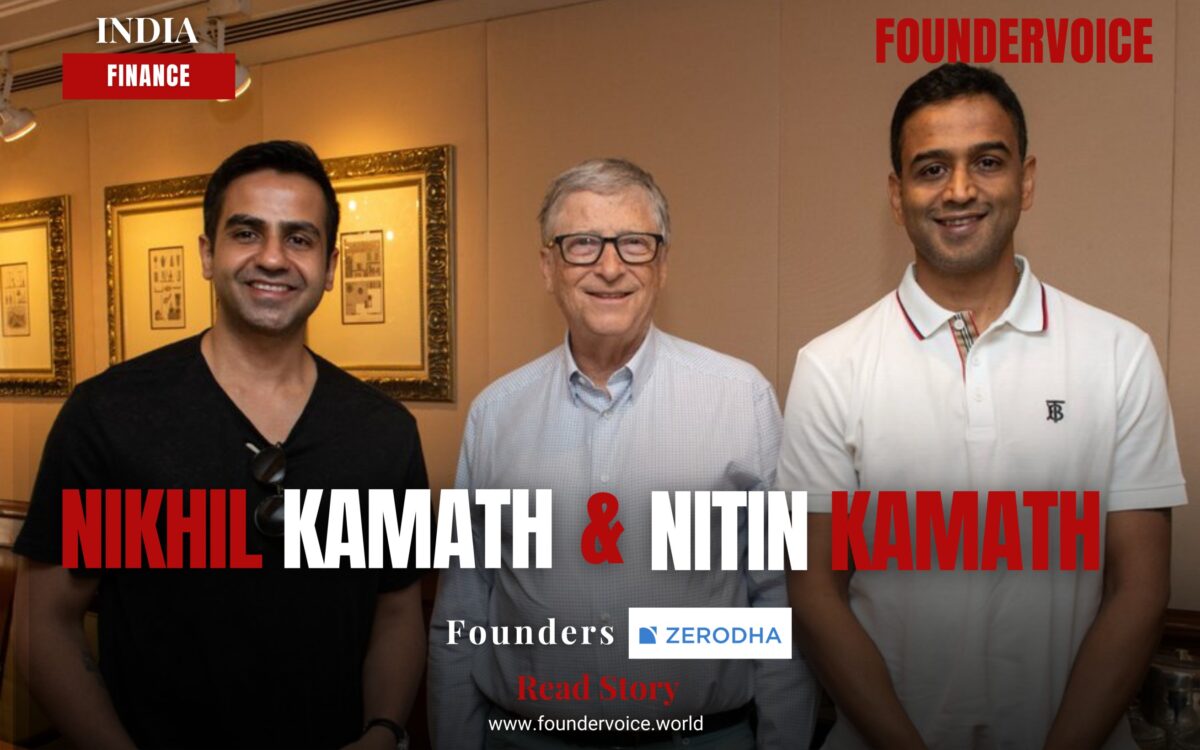


Nithin Kamath and Nikhil Kamath story is an inspiring story. They are the founders of Zerodha, which was started in August 2010 in Bengaluru, India. Today, Zerodha’s self-assessed valuation is estimated at around $3.6 billion. The company serves over 16 million (1.6 crore) active users across India as of 2025. Zerodha solves the problem of expensive, complex and inaccessible stock broking for ordinary investors by offering a low-cost, technology-driven online brokerage platform that makes trading and investing simple and affordable.
Company Overview
| Origin Country | India |
| Legal Name | Zerodha Broking Limited. |
| Brand | Zerodha |
| Founders | Nithin Kamath and Nikhil Kamath |
| CEO | Nithin Kamath |
| Industry | financial services |
| Website | https://zerodha.com/ |
| Year of Founding | August 2010 |
| Valuation | 3,216.52 crores |
| Employees | approximately 3,000 to 3,200 |
| Headquarters | Bengaluru, Karnataka, India |
| Status | Active |
FOUNDER OVERVIEW: NITHIN KAMATH & NIKHIL KAMATH
➤ Net Worth (2025)
Nithin Kamath’s net worth is estimated to be between 2.6–2.8 billion USD, primarily driven by his significant ownership in Zerodha and consistent annual profits from the company.
Nikhil Kamath’s net worth is estimated to be between 2.4–2.6 billion USD, supported by his equity in Zerodha and his success with True Beacon and other investment ventures.
Both brothers have maintained a philosophy of bootstrapping, zero external funding, and profit-driven growth, which has kept their personal wealth closely tied to Zerodha’s stable financial performance.
➤ Ownership in Company
Nithin Kamath and Nikhil Kamath continue to retain one of the strongest founder-level ownership positions in Zerodha, with the duo together holding nearly the entire company, since Zerodha has never raised external VC funding. Their ownership strength comes from a deliberate strategy of building a highly profitable, debt-free, and independently run business without dilution. By avoiding traditional funding rounds, they ensured that Zerodha remained a founder-controlled company with complete autonomy over its systems, pricing, and long-term direction.
➤ Ventures Founded
- Zerodha (2010) — Core brokerage / trading platform offering equities, derivatives, commodities, mutual funds, and related financial services.
➤ Investments
Nikhil & Nitin Kamath — known for co-founding Zerodha — has in the past publicly mentioned that he invests in startups, cryptos, and public markets. However, he doesn’t maintain a publicly shared portfolio..
➤ Recognition & Awards
Economic Times Startup Awards – Bootstrap Champ (2016)
Awarded to Zerodha for building one of India’s largest financial platforms without external funding, highlighting the Kamath brothers’ disciplined, sustainable growth model.
Forbes India – Person of the Year (2018)
Nithin Kamath was recognized for democratizing retail investing in India and reshaping how millions participate in the stock market.
Forbes 30 Under 30 Asia (2016) – Finance & Venture Capital
Nikhil Kamath was featured for his early achievements as a trader and for transforming discount broking through technology-led innovation.
Business Today Best CEOs Award (2020)
Nithin Kamath was honored for leading one of India’s most profitable fintech companies and redefining transparent, customer-first stockbroking.
LinkedIn Top Voices – Finance (Multiple Years)
Acknowledged for sharing practical insights on investing, markets, and entrepreneurship, inspiring India’s new generation of traders and investors.
➤ Connect with Nitin Kamath on Social Media
➤ Connect with Nikhil Kamath on Social Media
PERSONAL STORY: NITHIN KAMATH & NIKHIL KAMATH
Nithin and Nikhil Kamath hail from middle-class roots, growing up in a family where discipline, modesty, and financial prudence were valued. Their upbringing instilled respect for education, hard work and self-reliance. Seeing their father working steadily and their mother devoted to her passion for music/arts (or similar middle-class vocation) gave them early insight into the value of perseverance, honesty and long-term thinking.
Before starting Zerodha, both brothers had experience as individual traders and investors. They witnessed first-hand how traditional brokerage in India was expensive, slow, paperwork-heavy, and largely inaccessible to everyday people. Their early years involved frustration with high brokerage fees, opaque systems, and poor service — issues common for retail investors. These pain points planted the seed of building something better.
The Kamath brothers pursued formal education — though neither came from ultra-elite backgrounds. Their academic experiences provided them with foundational knowledge about economics, markets, and financial principles. More importantly, they learned discipline, analytical thinking, and developed a grit to challenge conventional career paths. Outside academics, they spent hours reading about stock markets, macroeconomics, financial news, and gradually built the confidence needed to trade, invest, and dream bigger.
Their journey wasn’t smooth. Early on, they had to manage uncertainty: income was volatile, as returns from trading weren’t assured. There was no guarantee that their low-cost brokerage experiment would succeed. The lack of backing from investors meant they bore all financial risk themselves. The pressure of supporting costs out of personal savings, facing potential losses, and handling investor skepticism (from friends/family or peers) weighed on them. Emotional stress, fear of failure, and the burden of responsibility to deliver something meaningful for retail investors — all were part of their personal struggle.
Beyond finances, personally they had to overcome doubts from society: challenging a traditional career path of “secure job in bank/firm” to embrace entrepreneurship in a risky field like stock broking — a decision many viewed with scepticism.
Despite setbacks, they remained committed to their values: transparency, affordability, simplicity, and customer trust. As Zerodha gained traction, first 60,000 customers, then thousands more, their confidence grew. Seeing ordinary Indians — students, small-business owners, salaried professionals — use Zerodha to invest and build wealth gave them a sense of purpose. They realized they were not just building a company but enabling a financial revolution.
Their mindset shifted from “let’s make money” to “let’s democratize investing.” This shift grounded their decisions: no flashy advertising, no pushing for surface-level growth, no compromising on cost or clarity. Instead they focused on building robust technology, simplifying processes, and delivering value — even if that meant slow, steady growth. Over time, as Zerodha became a trusted brand for millions, they started seeing themselves not just as entrepreneurs, but as enablers of financial inclusion and long-term wealth creation for average Indians.
FOUNDING STORY: ZERODHA
Inspiration Behind the Idea
The idea for Zerodha originated from personal frustration. As active traders themselves, the Kamath brothers experienced the inefficiency, high cost and complexity of traditional broking in India. Paperwork was extensive — opening an account required physical forms, signatures, couriering documents — a long, tedious process. They saw how this discouraged small investors and retail participants. They believed that if access to financial markets could be simplified and costs drastically cut, millions of Indians could benefit — not just seasoned investors.
They also believed strongly in technology: internet penetration was rising, smartphone adoption was picking up, and digital identity verification systems (eKYC, eSign, Digilocker) were emerging. These macro changes created a sweet spot to build a brokerage platform that was lean, online-first, and customer-driven. That conviction — that investing shouldn’t be a privilege but a right for common people — became the founding vision.
In August 2010, in Bengaluru, they launched Zerodha with the ambition to make investing affordable, accessible and transparent.
Founding Team
Zerodha was born out of the partnership between two brothers — Nithin and Nikhil. Their bond, shared vision, and complementary strengths created the foundation. Nithin, naturally inclined to technology, product thinking, and strategy, took on the role of CEO and product-architect. Nikhil, with strong trading acumen, market understanding and risk sensibility, complemented Nithin’s skillset. Their mutual trust and shared values formed the core of the founding team.
In initial days, with limited resources and no outside funding, the founding “team” was just the two of them plus a handful of early hires — people who believed in their vision of democratizing investing rather than chasing quick money.
Starting Capital
Zerodha was bootstrapped. There were no external investors, no massive seed funding, no hype rounds. The initial capital came from the founders themselves. They invested minimally — just enough to build a basic website, set up infrastructure, legal registration, and cover early operational costs. Their commitment to a lean, cost-conscious model meant that they did not spend on marketing or expensive offices. From the start they focused on delivering value through product and service, not flashy growth hacks.
Their personal sacrifice was high: uncertain incomes, long working hours, and the risk of losing everything if the idea failed. But their belief in the mission — to make investing accessible for millions — motivated them to persist.
Early Challenges
The early days were extremely challenging for the Kamath brothers. Before Zerodha became India’s largest brokerage, Nithin had spent years trading in the stock market, losing money, rebuilding, and learning the hard way how broken the Indian trading ecosystem was. Convincing people that a discount brokerage model with near-zero fees could even survive was one of the biggest hurdles. Many industry veterans doubted the concept. Traditional brokers dismissed the idea outright, saying that retail traders would never trust a low-cost, tech-first platform.
Bringing customers on board was tough too. Most traders were used to high-brokerage firms with physical offices, personal relationship managers, and old-school processes. When Zerodha launched with a 100% online onboarding system, many users were skeptical. Some signed up but hesitated to transfer funds because a young, bootstrapped company without big investors seemed risky to them.
Technology posed another major challenge. Zerodha’s vision required building Kite, Coin, Console, instant fund transfers, charting systems, risk engines, and back-end infrastructure — all from scratch. In 2010, India’s fintech ecosystem was still immature, and hiring skilled engineers was difficult for a self-funded startup. Every system outage, app crash, or high-traffic day added immense pressure on the tiny team working around the clock to stabilize the platform.
Yet, Nithin and Nikhil stayed focused. They kept improving the product, fixing issues personally, answering customer queries, refining the tech stack, and patiently educating retail investors through initiatives like Varsity and TradingQnA. These difficult years built the trust, stability, and tech foundation that later turned Zerodha into the most profitable fintech startup in India.
Breakthrough
The major breakthrough for Zerodha came when it launched Kite, its modern, fast, and clean trading platform. For the first time, Indian traders experienced a brokerage interface that was simple, lightweight, and built for speed. This instantly set Zerodha apart from traditional brokers.
The introduction of zero brokerage for equity investments and extremely low intraday charges further accelerated user adoption. Traders realized that they could save massive costs while using a platform that felt far ahead of the industry. Word-of-mouth spread rapidly — Zerodha became India’s first brokerage to grow without advertising or funding.
A second breakthrough came with Varsity, the free and open educational platform that transformed millions of Indians into informed investors. This strengthened the brand’s trust and community loyalty.
COMPANY PROFILE: ZERODHA
Zerodha offers online stock broking, trading and investment services — providing ordinary investors access to equities, derivatives, commodities, mutual funds, and other financial instruments through a simple, low-cost, technology-driven platform.
Area Served
India
Its primary and only operational market. Zerodha serves millions of traders and investors across all Indian states and cities, with deep penetration in metro, tier-2, and tier-3 locations through its online platforms.
Online Pan-India Presence
Since Zerodha is a fully digital brokerage, users from anywhere in India can open accounts, trade, invest in mutual funds, track portfolios, and learn through platforms like Varsity and TradingQnA.
Global Reach (Educational & Content Only)
While Zerodha does not offer brokerage services outside India, its learning platforms, blogs, and educational content are accessed by users worldwide for financial literacy and trading knowledge.
Vision & Mission
Vision: Democratize access to financial markets in India — make investing and trading simple, affordable and accessible to every Indian, regardless of background or wealth.
Mission: : Provide a transparent, low-cost, user-friendly brokerage platform built on technology and integrity — empowering retail investors to take control of their financial future.
Services / Products Offered
- Equity trading and investing (stocks)
- Derivatives trading (Futures & Options, commodities)
- Commodities trading
- Mutual fund investments (via integrated platform)
- Demat account and custody services (for holdings)
- Market-education initiatives and content to help users understand investing
Fintech tools and backend infrastructure for trading and investment operations
Business Model
Zerodha’s business model focuses on low-cost, tech-driven, customer-centric brokerage services that scale with high volumes of users and trades.
Revenue Model
1. Equity Trading
– Delivery trades (stocks held long-term): ₹0 per trade
– Intraday and Futures & Options (F&O) trades: Flat ₹20 per executed order
2. Commodity & Currency Trading
– Flat ₹20 per trade
3. Mutual Funds (Coin platform)
– Direct mutual funds without commission
– Revenue generated indirectly via platform growth and increased client base
4. Margin Funding
– Interest earned from clients using leverage for intraday and F&O trading
5. Subscription Tools & Analytics
– Paid services such as Smallcase, Streak, and Sentinel
6. Software & Tech Solutions
– Premium features in Kite (trading platform) and Coin (mutual fund platform)
Market Landscape & Competitors
As of 2025, India’s fintech and online brokerage landscape is highly competitive, rapidly expanding, and increasingly technology-driven. Zerodha operates in a market where user expectations for low fees, fast execution, advanced tools, and transparency continue to rise.
Key competitors include:
Groww – A rapidly growing investment platform targeting millennials with a simplified UI.
Upstox – A major discount brokerage backed by global investors, offering competitive pricing and trading tools.
Angel One – A long-standing brokerage modernizing its technology stack while retaining a large offline network.
5paisa – Low-cost trading platform positioned for price-sensitive retail investors.
ICICI Direct & HDFC Securities – Full-service brokers offering integrated banking + trading experiences with strong trust value.
These competitors challenge Zerodha across multiple fronts — pricing, product ecosystem, user experience, market education, mobile-first tools, and customer support.
Yet, Zerodha maintains a leading position due to its bootstrapped model, profitability, stable systems, innovative platforms like Kite, and unmatched trust built over a decade.
USP (Unique Selling Proposition)
Ultra-Low-Cost Brokerage Model
₹0 commission on equity delivery and extremely low intraday charges — a pricing revolution that transformed India’s stockbroking industry.
Powerful In-House Trading Technology
Fast, reliable, and minimal-design platforms like Kite, Coin, Console, Sentinel built entirely in-house, ensuring full control, stability, and superior user experience.
Bootstrapped & Profitable Growth
No external funding, no aggressive burn — Zerodha scaled purely through product strength, trust, and customer loyalty, making it one of India’s most profitable fintechs.
Deep Focus on Education & Transparency
Initiatives like Varsity, TradingQnA, and open reporting established Zerodha as India’s most trusted brand for beginner as well as advanced traders.
Customer-Centric Simplicity
Clean UI, transparent charges, instant onboarding, and seamless usability — everything designed to reduce financial complexity for everyday Indians.
Growth Highlights
- 2010: Zerodha founded with a mission to make trading affordable
- 2015: Crosses 1 lakh active traders; launch of Kite beta
- 2017: Emerges as India’s largest retail stockbroker
- 2020: Massive surge in new investors during pandemic; record profitability
- 2021–2025: Strong focus on tech upgrades, education, risk management, and sustainable growth
Funding & Investment History
Zerodha stands out in India’s startup ecosystem as one of the few large-scale unicorns built entirely without external funding.
Since its inception in 2010, the Kamath brothers have never raised venture capital, never taken equity investment, and have scaled Zerodha purely through bootstrapped, revenue-driven growth.
This self-funded approach allowed Zerodha to remain profitable from early years, maintain full ownership, reinvest earnings into technology, expand trading platforms, and build investor education initiatives like Varsity, TradingQnA, and Rainmatter.
Instead of seeking funding, Zerodha became an investor itself through Rainmatter, supporting Indian fintech and financial wellness startups.
Awards & Recognition (Company)
- Economic Times Startup Awards – Bootstrap Champ (2016)
- Honored for building one of India’s most successful and profitable startups without external funding.
- Forbes 30 Under 30 India (2016) – Finance Category
- Recognized for transforming India’s investing landscape through low-cost, technology-first broking.
- Nasscom Emerge 50 Award
- Awarded for innovation and impact in fintech and digital trading infrastructure.
- Business Standard Annual CEO Award – Nithin Kamath (2023)
- Celebrated for steering Zerodha’s consistent growth, profitability, and trust-driven business model.
Team Size & Culture
Zerodha has a lean team of around 1,200–1,500 employees, known for a culture built on transparency, innovation, and calm execution. Unlike typical high-pressure startups, Zerodha promotes a no-hustle, sustainable work environment, encourages deep work, and avoids unnecessary meetings.
The Kamath brothers focus on trust, autonomy, and long-term thinking, allowing teams to experiment, build user-centric products, and maintain the company’s strong profitability without external funding.
Future Plans
- Expanding and upgrading technology infrastructure
- Strengthening long-term investment ecosystem through platforms like Coin
- Deepening financial education via Varsity
- Building more tools for retail risk management & financial discipline
- Supporting fintech innovation through their investment arm, Rainmatter
Connect with Company’s Official Social Media
CONCLUSION
“Investing is not about making quick money — it’s about building wealth with patience, clarity, and discipline.” — Nithin Kamath
The journey of Nithin and Nikhil Kamath with Zerodha highlights a remarkable lesson: success does not require external funding, hype, or shortcuts. By bootstrapping, focusing relentlessly on technology, and putting the customer first, the Kamath brothers created India’s largest discount brokerage while maintaining complete control of their vision. Their story demonstrates that clarity of purpose, discipline, and long-term thinking can transform industries, empower millions, and leave a lasting impact. Zerodha stands as proof that innovation paired with integrity can redefine an entire market.